Keeping in view need to improve availability of adequate housing in the country and important role of construction sector in boosting economic activities in other countries, Government of Pakistan envisions to increase the number of housing units manifold in coming years and has taken several measures in this regard. To support this vision of Government of Pakistan, the SBP has taken several measures since July 2020 to support the provision of financing for the housing and construction sector. In October 2020, the Government of Pakistan augmented these efforts by introducing the Government Markup Subsidy Scheme, now commonly known as Mera Pakistan Mera Ghar (MPMG) markup subsidy Scheme. Government liberalized features of MPMG scheme in light of feedback of stakeholders to benefit the larger strata in March 2021. Available in both conventional and Islamic mode, this scheme enables banks to provide financing for the construction and purchase of houses at very low financing rates for low to middle income segments of the population. The SBP is the executing partner with Government of Pakistan and Naya Pakistan Housing and Development Authority (NAPHDA).
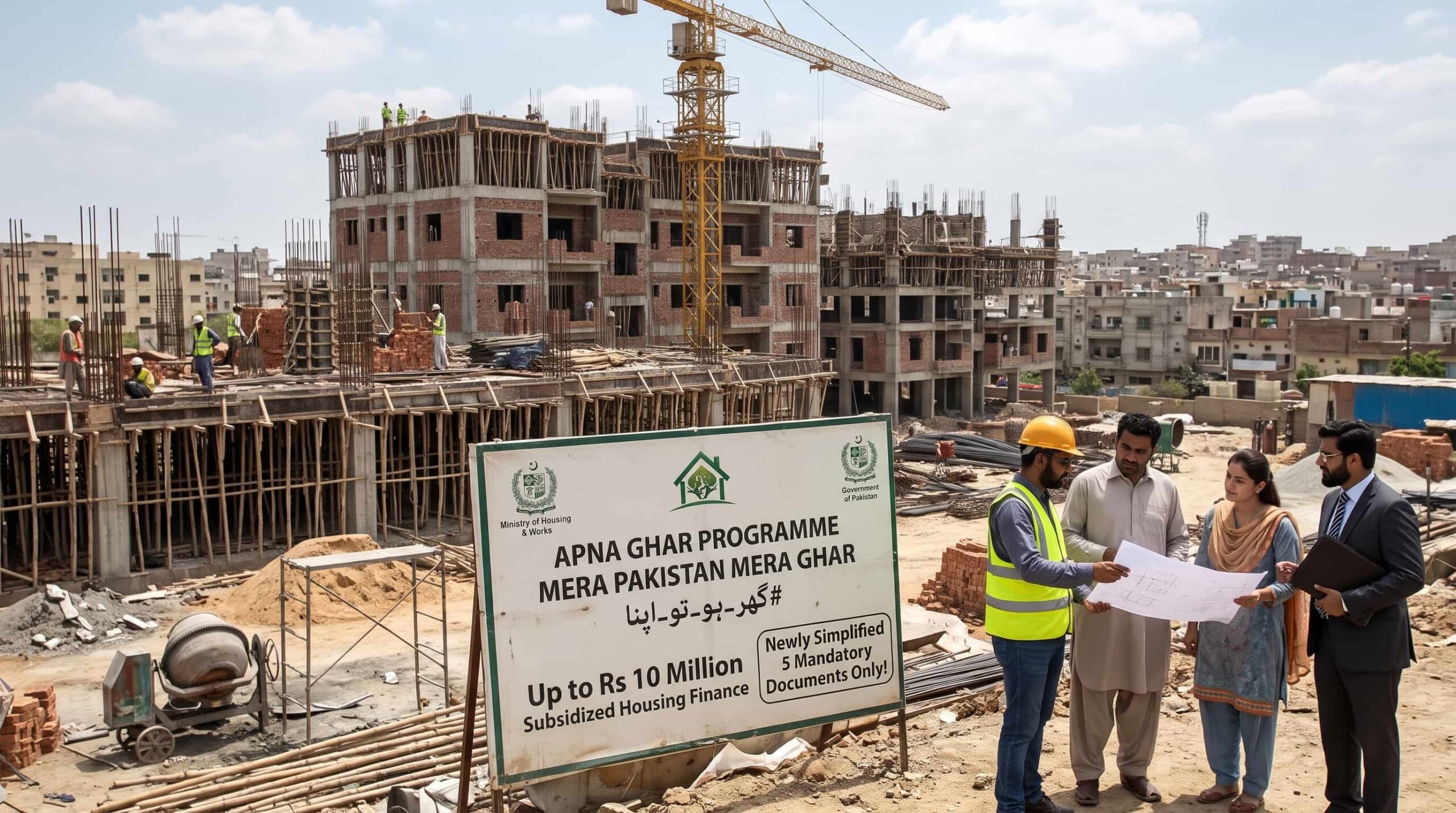
Prime Minister’s Apna Ghar Programme is a nationwide housing finance initiative of the Ministry of Housing and Works, offering loans of up to Rs 10 million for home construction. The prime minister’s Ghar Ho Tu Apna scheme, launched in September last year, created demand for housing. The scheme offers subsidised financing at a fixed rate of five per cent, with markup subsidy paid by the government.
Financing availed under MPMG Scheme can be used for:
- Purchasing a house/ flat/apartment
- Purchasing a plot and construction there upon
- Extension in pre-owned housing unit
- Construction on already owned plot
Customer can choose financing tenor from 5 to 20 years.
Eligibility:
- All Pakistanis with valid CNIC and NICOP
- First time house owner
- One individual can have subsidized house loan facility under this scheme only for once
- For Naya Pakistan Housing and Development Authority (NAPHDA) projects, NAPHDA will shortlist the eligible candidate and upon request of candidate, will forward the candidate profile to banks for financing
Two types of loan can be availed: For NAPHDA Projects and For Non-NAPHDA Projects. Up to Rs. 2.7 million can be financed under this category. Financing is available for house measuring up to 125 Square Yards (5 Marla) with maximum covered area of 850 Square Feet. Flat/apartment with maximum covered area of 850 square feet will be financed. To be eligible under MPMG, maximum price (Market Value) of a single housing unit at the time of approval financing shall not exceed Rs. 3.5 million.
For NAPHDA Projects (Tier 1):
- Borrower will be charged financing rate of:
- 3 percent for first five years
- 5 percent for next five years
- KIBOR + up to 250 bps for the remaining financing tenor
For Non-NAPHDA Projects:
- Tier 0: For Microfinance Banks Borrowers
- Borrower will be charged financing rate of:
- 5 percent for first five years
- 7 percent for next five years
- KIBOR + 700 bps for the remaining financing tenor
- Borrower will be charged financing rate of:
- Tier 2: For Commercial Banks/DFIs Borrowers
- For financing a house measuring up to 5 Marla (125 Square Yards) and for a flat/apartment with the size up to 1,250 Square Feet, financing rate will be charged as follows:
- 5 percent for first five years
- 7 percent for next five years
- KIBOR + 400 bps for the remaining financing tenor
- For financing a house measuring up to 5 Marla (125 Square Yards) and for a flat/apartment with the size up to 1,250 Square Feet, financing rate will be charged as follows:
- Tier 3: For Commercial Banks/DFIs Borrowers
- Financing to be availed for a house measuring up to 10 Marla (250 Squard Yards) and a flat/apartment up to 2,000 Square Feet, financing rate will be charged as follows:
- 7 percent for first five years
- 9 percent for next five years
- KIBOR + 400 bps for the remaining financing tenor
- Financing to be availed for a house measuring up to 10 Marla (250 Squard Yards) and a flat/apartment up to 2,000 Square Feet, financing rate will be charged as follows:
The government has simplified property documentation requirements for banks under the Prime Minister’s Apna Ghar Programme, reducing the number of mandatory documents for housing finance to five to facilitate access to loans for prospective homeowners. The State Bank of Pakistan (SBP) has issued formal instructions to banks in this regard on the directives of Prime Minister Muhammad Shehbaz Sharif, an official spokesperson for the Ministry of Housing and Works told APP. Under the revised requirements, banks will require five essential property-related documents for housing finance under the scheme, including a transfer and possession letter, a site plan, a mortgage permission letter and registration of the mortgage. The spokesperson said the measures aimed to simplify the loan application process, reduce procedural hurdles and improve access to housing finance for people seeking to build their own homes. Previously, complaints had been received from applicants about banks demanding a large number of documents, creating delays and complications in obtaining housing loans. She said the revised requirements would provide significant relief, particularly to first-time homebuilders, by making the loan application process more convenient and accessible.
State bank has taken various regulatory measures to create conducive regulatory environment, few of them are listed below:
- Relaxation of DBR in case bank rely on repayment surrogate for extension of financing
- In case of use of informal income estimation models, banks will be exempt from requirement of verifiable income only.
- Banks/DFIs are allowed to extend low cost housing finance against personal guarantee of a third party for a maximum period of one (01) year.
- Standardized loan application form
- Standardized Facility Offer Letter
- Standardized set of documents required for financing approval
- Standardized set of property documents required for disbursement of financing
- Punjab Government’s online portal for banks to verify
- Punjab and KPK’s online portal listing approved projects
- Launch of online complaint management system for Government Markup Subsidy Scheme: SBP developed an online complaint management system and made it live, where complaint resolution time is maximum 8 working days, banks have nominated focal persons for each region for complaint resolution, and all SBP BSC offices are also involved.
- The State Bank has also established help desks in its 16 offices across the country to facilitate applicants in registration of their complaints through the IT portal to address access challenges of applicants arising out of potential language and technology barriers.
- Implementation of standardized income proxy model developed by banks to facilitate housing finance to customers with informal sources of income
- Development and implementation of advanced Statistical scorecard Model for housing finance, pursuing banks to develop comprehensive statistical scoring models to ensure flow of formal housing finance to individuals employed in informal sector
- Development of technological solutions for acquisition of data from primary sources (telcos, utility companies, Government agencies, etc.) to improve the traditional credit approval process to a scorecard and behavior pattern analysis.
The country has been facing a shortage of houses while the cost of construction has gone up many times over the last five years. According to an estimate, the country requires up to 10 million houses at a time when 48 per cent of Pakistanis are living below the poverty line. “Most people can’t buy even an apartment since the purchasing price is out of reach of the middle class. The housing scheme has provided liquidity and purchasing has picked up,” according to Hassan Bakhshi, chairman of the Association of Builders and Developers (Abad).
Although banks are not ready to extend housing loans to applicants without complete documentation, builders are almost unanimous that the sector had picked up over the last 12 months. According to them, the Prime Minister’s housing scheme, which provides loans of up to Rs10 million on easy instalments, has stimulated the construction industry. A builder said that after release of liquidity for housing schemes, a number of people in the business have been able to recover their investments stuck in apartments that were not booked earlier as people had no money.
“Banks have not issued loans as much as we were expecting, but they have some real issues,” said Mr Bakhshi. “Banks don’t issue loans unless documentation is complete.” “Most people start work on their homes without a proper design and approval of the Sindh Building Control Authority. Banks don’t consider these projects for loans,” he added.
According to an SBP report, construction activity had picked up pace following “some favourable developments”. The Public Sector Development Programme spending grew by 41.8pc in the first half of FY26, compared to a decline of 1.1pc in the corresponding period of last year. The growth in construction during the six quarters from FY25 to FY26 was amazing, shooting from a negative growth to as high as 19.2pc. The State Bank recently reported that the growth rate of the construction industry was negative 3.3pc during the first quarter of FY25, but it shot up to 17.6pc in the fourth quarter of the same fiscal year. The growth rate in the first quarter of FY26 was 19.2pc, while the first half of the same fiscal year recorded growth of 14.6pc. Prices of construction material have fallen considerably. But builders deny that prices have come down.
Hassan Bakhshi was, however, hopeful that the construction industry would soon pick up and it would, in turn, jumpstart over 70 allied industries. He said outflow of money from Pakistan to Dubai for purchase of property has declined as buyers divert their cash into real estate at home. Dubai, the most attractive place for buying and selling properties, lost its charm with the outbreak of the US-Iran war. Investors feel their liquidity in Dubai is stuck while the future is uncertain. Since the outflow of money for investing in Dubai properties has suddenly stopped, people flush with cash found it prudent to invest in real estate at home, which pushed up property prices in areas like Defence Society by up to 60pc. “The dust has settled now and a correction of up to 20pc in prices of properties in Defence has been noted over the last one month,” said Mr Bakhshi. Property prices have risen in almost all areas in Karachi, which serves as a barometer for the entire country, because people find no other alternative in the midst of the Gulf war.